
Showing posts with label graphic novel. Show all posts
Showing posts with label graphic novel. Show all posts
Seasonal Reading
| Labels: Cemetery Blues, comic, graphic novel, Ryan Rubio, Thomas Boatwright, trade | 0 comments
Interview: Lee Francis IV on Native Publishing, Bookstores & Indigenous Comic Con
| Labels: Arigon Starr, graphic novel, independent publishers, Indigenous Comic Con, Jonathan Nelson, Lee Francis IV, Native American/First Nations | 0 comments |
| Lee Francis IV |
for Cynthia Leitich Smith's Cynsations
Lee Francis IV is CEO/Publisher of Native Realities, owner of Red Planet Comics & Books store in Albuquerque, New Mexico, and Organizer of Indigenous Comic Con.
Native Realities swept the Middle Grade category of 2018 award winners from the American Indian Library Association.
First, Tales of the Mighty Code Talkers, the 2016 comic book wins the category!
(Tales of the Mighty Code Talkers was edited by Arigon Starr (Kickapoo) and featured the work of Theo Tso (Las Vegas Paiute), Jonathan Nelson (Diné), Kristina Bad Hand (Sičháŋǧu Lakota/Cherokee), Roy Boney Jr. (Cherokee), Lee Francis IV (Laguna Pueblo), Johnnie Diacon (Mvskoke/Creek), Weshoyot Alvitre (Tongva), Renee Nejo (Mesa Grand Band of Mission Indians) and Michael Sheyahshe (Caddo)).
And then The Wool of Jonesy, a 2016 wordless comic takes the Honors category.
Lee, I’m so excited for you! Tell me what it was like getting that news.
Thanks so much! It was so exciting!

The work that Arigon Starr and Jonathan Nelson put into each book was absolutely worth recognition. They are amazing artists and colleagues and I am so honored to have been a part of the publication of their work.
Share with us some about your history with Native literature and publishing.
My family has a long background with Native lit.
My dad was an historian and published Native Time back in the early '90s and was the founder of Wordcraft Circle of Native Writers and Storytellers.
My aunt (dad’s sister) was Paula Gunn Allen. His other sister was Carolee Sanchez. And our Laguna cousin is Leslie Marmon Silko. So Native lit runs in the blood, I suppose.
I spent a number of years as the office support staff for Wordcraft and had the chance to meet and interact with a number of Native literary icons throughout the 90s.
In 2003, when my dad crossed over, I began working as the Director of Wordcraft and continued to expand the work, networking and doing workshops with Native youth.
We moved into publishing in 2012 with our first comic: INCs Universe and I never looked back. It’s been amazing to be a part of the Native literature movement, especially as all these new voices are being published, both by us and by a number of new and mainstream publishing houses who understand the value of including Native voices in the literary cannon.
Why did you decide to found Native Realities? Give us an idea of your journey and some of the challenges you’ve encountered in doing so.

There are great children’s books and some young adult and then a whole bunch of adult lit but not anything that would help bridge the gap for those readers who might need more graphics.
We also wanted, and still want, to work in changing the perceptions and representations of Native people by presenting stories of Native people as superheroes and unlocking the Indigenous imagination.
I am tired of our people being portrayed as “tragic stereotypes” in pop culture media and I figured I could do something to change that.
The biggest challenges have been learning how the publishing industry works from the publisher-side.
I had been a writer and had worked with writers for many years, so I had a basic understanding. But really digging into contracts, publishing schedules, layout, editorial decisions and whatnot has been eye-opening.
What else does Native Realities have coming up that readers can look forward to?
Sixkiller, my comic is set to release end of March. Illustrated by the incomparable Weshoyot Alvitre, it is the story of Alice Sixkiller and her quest to get revenge for the murder of her sister.
After that, we have the next issues of Tribal Force and Hero Twins. We also have a Water Defenders book we will take to Kickstarter here in the next few months. And we hope to finish our American Indians of Texas comic, a project we started several years ago and have been building out for a while. Of course, there may be more surprises along the way!
 |
| Native Realities booth at the American Library Association Conference |

People can contact us at info@nativerealities.com. Just to note, any work must be Indigenous-centric and must be led by a (self-identified) Indigenous person.
In the words, the Indigenous team lead can bring in whomever they choose to help create the books but they must be the artistic drivers as one of our other goals is to help professionalize/support the careers of Native creators.
Red Planet Books & Comics is one of the few Native-owned independent bookstores that I know of in the United States. What prompted you to open the bookstore in downtown Albuquerque last June? What do you enjoy most and what is most challenging?
We opened Red Planet so we could keep the party going on all year-round!

It is also an extension of the Comic Con, i.e. rather than just a weekend when you could get some cool Indigenerd stuff, we could have a location where you could purchase throughout the year. The final reason was so that we could control the distribution and sales from end to end.
As Native folks, our work is often crowded out in the marketplace. This way there would be a dedicated shop to promoting Native works, as we are only one of three shops in the United States that focus almost exclusively on Native works.
 |
| Lee greets visitors on opening day at Red Planet Books & Comics |

We want to try and build a whole narrative that ties all the pieces together, vendors, performers, guests, and give folks, especially Native youth, a unique experience that is immersive and completely engaging. We’re hoping to work with more artists to help us conceive this over the coming months.
We also hope to land a few new guests this year, as well as bring back some of our old friends.
It should be another amazing year for us and we hope to see everyone in New Mexico in November!
 |
| Cosplayers at ICC 2017 |
I’m currently working on a Pueblo Futurisms YA book, hopefully it will be published in the near future. That’s about all I can say right now.
Anything else you’d like to add for our readers?
Please continue to support the work of Native creators. It’s great to like and share but we have to keep providing resources so we can continue to create. Help us continue to unleash the Indigenous imagination!
Cynsational Notes
 Dr. Lee Francis IV (Pueblo of Laguna) is the Head Indigenerd and CEO of Native Realities, the only Native and Indigenous pop culture company in the United States.
Native Realities is also the host of the Indigenous Comic Con and Red Planet Books and Comics.
Native Realities has published 10 titles to date with more on the way.
His hope is to change the perceptions of Native and Indigenous people through dynamic and imaginative pop culture representations.
Traci Sorell covers picture books as well as children's-YA writing, illustration, publishing and other book news from Indigenous authors and illustrators for Cynsations. She is an enrolled citizen of the Cherokee Nation.
 Her first nonfiction picture book, We Are Grateful: Otsaliheliga illustrated by Frané Lessac, will be published by Charlesbridge on Sept. 4, 2018.
The story features a panorama of modern-day Cherokee cultural practices and experiences, presented through the four seasons. It conveys a universal spirit of gratitude common in many cultures.
In fall 2019, her first fiction picture book, At the Mountain’s Base, illustrated by Weshoyot Alvitre will be published by Penguin Random House’s new imprint, Kokila.
Traci is represented by Emily Mitchell of Wernick & Pratt Literary Agency.
Author-Teacher Interview: Gene Luen Yang on Writing, Teaching & the Hamline MFA Program
| Labels: diversity, Gene Luen Yang, Gene Yang, graphic novel, Hamline, MFA, teaching | 0 comments |
| Lean more about Cartoonist and Teacher Gene Luen Yang. |
for Cynsations
Welcome to Cynsations. We last spoke to Dean Mary Francoise Rockcastle about the Hamline MFA in Writing for Children and Young Adults back in 2006.
When did you join the faculty? What appealed to you about teaching in a low-residency program?
I joined the faculty of the Hamline MFAC program in the summer of 2012. I visited maybe a year or two before that as a guest speaker. I was only there for a day or two, but I was immediately impressed by the sense of community.
Hamline is a community centered around stories. Everyone is there to learn, and everyone is there to teach.
The low-residency program makes for an intimate experience. This past semester, for instance, I worked with three students. Some faculty take on more, of course, but not that many more.
When you're working at that scale, you can give a lot of individualized attention. I can get to know them as writers. I can be more invested in their stories.
What has teaching taught you about your own creative craft and process?
 |
| Laura Ruby at Hamline; cover of The Real Boy by Anne Ursu (Walden Pond) |
A few semesters ago, my fellow faculty member Laura Ruby (winner of the 2016 Printz Award) gave a lecture on the objective correlative. I think about that all the time now, whenever I'm writing.
Like, all. The. Time.
And those are just a handful of examples. A community has collective wisdom, so when you're a part of a community, you get to tap into that wisdom.
In addition, preparing and delivering a lecture forces you to really wrestle with your ideas. I've always worked through plot and characterization and setting by instinct, which is kind of like walking through your own room in the dark. You know where everything is, generally speaking, but you're still going to stub your toe every now and then. Teaching plot and characterization and setting is like turning on the light.
Who else is on the faculty, and how would you describe the culture of your learning community?
I have to tell you, the Hamline faculty roster is stacked. Here's the full list of my fellow faculty members: Swati Avasthi, Kelly Barnhill, Coe Booth, Marsha Wilson Chall, Matt de la Peña, Lisa Jahn-Clough, Emily Jenkins, Ron Koertge, Nina LaCour, Mary Logue, Jacqueline Briggs Martin, Meg Medina, Claire Rudolf Murphy, Phyllis Root, Laura Ruby, Gary Schmidt, Eliot Schrefer, Sherri L. Smith, Laurel Snyder, and Anne Ursu.
 |
| Learn more about Emily Jenkins. |
I've experienced Hamline to be a place that welcomes every kind of story. The MFAC folks are willing to grow and push and learn.
From your own experience (and those who came before), what growth and changes have you/they seen in your program?
I've seen students grow in skill, of course. They come away with better understandings of the craft itself. They learn to critique constructively. They learn to structure and revise. They learn to give from themselves through story.
And just as importantly, they learn to call themselves writers. Many of us write in isolation. Many of us are in families or friend groups that enjoy stories, but don't really see their relevance. Many of us feel embarrassed to call ourselves writers.
Being a part of a writing community, getting to discuss the minute details of what makes a story work... if you haven't yet given yourself permission to call yourself a writer, it may be because you need to join a writing community.
Could you describe a typical residency?
Residencies are about nine days long.
 |
| Kate DiCamillo teaches a master class at Hamline. |
Topics go through a five-residency cycle: point-of-view, setting, plot, character, theme.
Faculty will sometimes lead workshops focusing on a specific skill.
Gary Schmidt has done one on writing a great opening chapter. Swati Avasthi taught one on manipulating time.
I've done a workshop on writing a graphic novel script.
How about a typical advisor-advisee semester of writing and study?
At the end of the residency, students are assigned a faculty advisor. Each student meets with their advisor to talk over goals and figure out a game plan. Then, over the course of a semester, the student turns in four packets, typically one a month. Packets usually contain forty pages of writing.
Based on the previously-discussed goals, faculty will go over the packet and write a response letter. Some faculty also do phone calls. I usually have an email exchange in addition to the response letter. My relationship with my students is a bit like my editor's relationship with me.
What do you like best about teaching at Hamline?
I love being a part of the Hamline community. I know I'm there to teach, but I feel like I learn so much.
I love hearing how other writers working in other formats and genres approach their craft. I love seeing my students grow in their storytelling prowess. I love seeing them grow in their confidence.
What would you say to a prospective children's-YA writer who is considering graduate study?

More personally, what was your own apprenticeship like?
I found a community. Early on, I fell in with a group of other comic book creators. We were all in our twenties. We were all at the start of our careers. We were all living in the Bay Area.
For years, we met once a week to write and draw together, and to look over each other's work.
I never went to an MFA program, so I consider that experience my MFA program equivalent. Almost everyone in that group has now been published in one form or another.
Do you have any particular insights to share for those interested in creating graphic-format literature?
Read lots of comics.
Read lots of everything, but especially comics.

Work through Jessica Abel and Matt Madden's Drawing Words and Writing Pictures (First Second, 2008).
After that, give it a go. There are no rules to making comics.
You can write a script or go straight to thumbnail sketches. You can use just about any drawing implement you want to make your pictures. Pick a strategy and a set of tools – don't worry about whether they're the right choices because you're not going to know until you've given them a try – and go.
What do you wish you had done differently? What choices were especially fruitful?
I am so, so fortunate to have had the journey I've had. I'm not sure I would have done anything differently, for fear of jinxing the whole thing.
I've just been incredibly blessed.
My most fruitful choice was joining that group of cartoonists when I was starting out. I got my first publisher through that group. Once one of us got connected, we would introduce everyone else.
What new or recent release of yours should we be sure to read?
I hope you'll check out Secret Coders (First Second, 2017-), the middle grade graphic novel series I'm doing with my friend Mike Holmes. Mike and I are blending a mystery story with coding lessons. The fifth and sixth volumes come out this year.

We're telling the story of a brand-new character in the DC Universe: Kenan Kong, a seventeen year old Chinese kid who inherits Clark Kent's powers and becomes the Super-Man of China.
What about that project sparked your imagination? What did it teach you in terms of craft and process?
Secret Coders is my first explicitly educational project. I was a high school computer science teacher for 17 years, so I've always been interested in education. Mike and I wanted to figure out how to use comics to teach.
I've done some things well and some things not so well. There are a few instances when I let the educational aspect overwhelm the narrative aspect. I think balance is key. Balance is always key.
What was it like, being a National Ambassador for Young People's Literature? Is there a moment that stands out in your memory?
Serving as National Ambassador for Young People's Literature was perhaps the biggest honor of my life. I loved meeting Dr. Carla Hayden for the first time at the National Book Festival. I loved meeting young readers, young authors, and young cartoonists. I don't care what anyone says about videogames or YouTube or whatever. Kids today love books. Kids today are absolutely hungry for stories, and they love getting their stories through the pages of a good book.
What do you hope for the children's-YA creative community, looking into the future?
I hope for diversity in every sense of the word. I hope people from every corner of our society will tell their stories, and I hope they find folks who will listen to their stories. I hope authors will try out different publishing formats and genres. Heck, I hope authors invent new publishing formats and genres! I hope our world will be guided and nourished by good stories.
Troll Bridge
| Labels: bridge, Colleen Doran, Dark Horse, graphic novel, Neil Gaiman, stories, trolls | 0 comments
One of my favs from Neil Gaiman. Troll Bridge will be coming out as a graphic novel (Dark Horse) this September...
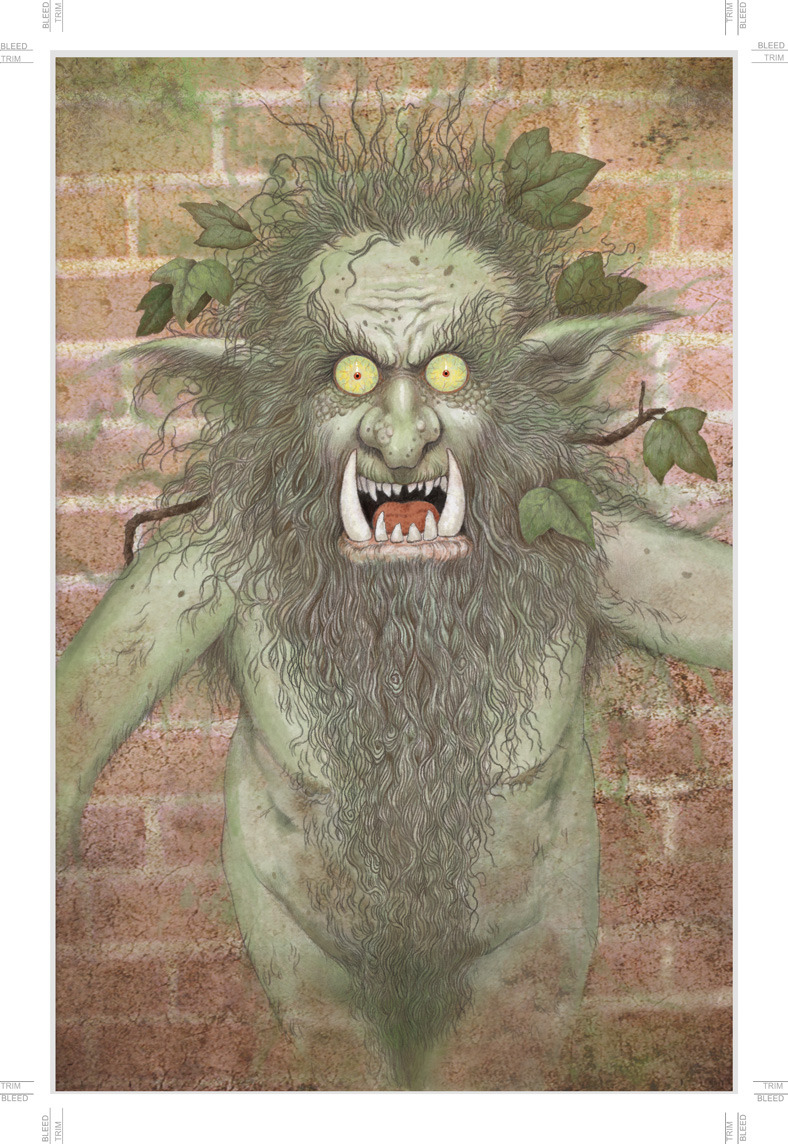 |
| by Colleen Doran - Source |
Ghost Ship Mystery - Phiip Pullman
| Labels: Fred Fordham, ghost ship, ghost stories, ghosts, graphic novel, Philip Pullman, The Guardian | 0 comments
Read the abridged extract from The Adventures of John Blake: The Mystery of the Ghost Ship here. It's a new graphic novel by Philip Pullman and illustrator Fred Fordham. Read more here.
 |
| Source |
Subscribe to:
Posts (Atom)