Showing posts with label Native American/First Nations. Show all posts

Native Author-Illustrator Interview: Jonathan Nelson

| | 0 comments
for Cynthia Leitich Smith's Cynsations

Today we welcome Diné (Navajo) artist Jonathan Nelson to discuss his journey as an illustrator and his recently published debut picture book.

Johnny, your Wool of Jonesy (Native Realities, 2016), a wordless graphic novel won the American Indian Library’s Association Middle Grade Honor Book Award earlier this year. 

Now your first picture book, First Laugh – Welcome Baby, written by the late Rose Ann Tahe, a fellow Diné creator, and Nancy Bo Flood (Charlesbridge, 2018), is out in the world. 

From the promotional copy:

The First Laugh Ceremony is a celebration held to welcome a new member of the community. 

As everyone—from Baby's nima (mom) to nadi (big sister) to cheii (grandfather)—tries to elicit the joyous sound from Baby, readers are introduced to details about Navajo life and the Navajo names for family members. 

Back matter includes information about other cultural ceremonies that welcome new babies and children, including man yue celebration (China), sanskaras (Hindu) and aquiqa (Muslim). 

What brought you to illustrate this book featuring Diné culture? 

Yes, thank you. It’s been crazy seeing this unfold with my art. I’ve been drawing since I was five years old, so I’ve been working at this a while now. It was Nancy Bo Flood who introduced me, and my work, to Charlesbridge. I shared my portfolio and they loved what they saw.

Although my recent work has been based around Jonesy and sheep, I was excited to change direction by illustrating Diné people.

Diné Man and His Hat, Ballpoint pen and whiteout on paper by Jonathan Nelson, used with permission.
Tell us about your illustration apprenticeship. How did you take your art from a beginner level to publishable? How has your style evolved over time? 

Well, I suppose my apprenticeship began in elementary school. It began with tracing. I traced Spider-Man, The Incredible Hulk, and X-Men.

In middle school, I started copying, because I wanted the character I was drawing to be larger on my ruled school paper. Without realizing it, I was learning about size, proportion, scale, space, and perspective.

In high school, I began drawing with a ballpoint pen, because I didn’t like how my sketchbooks were smudged with pencil drawings. I would still draw superheroes, but they became more expressive. Their features became more exaggerated; the arms and legs were longer and the hands and feet were bigger.

Frybread Warriors, Ballpoint pen on paper, 10”x 7,” 2016,
by Jonathan Nelson, used with permission.
After high school, I worked a lot of different jobs, but none were art-related. So, as an untraditional college student, I went back to school years later. I learned how to turn my drawings into shirt graphics or digital paintings.

It wasn’t until graduate school at University of Arizona when I developed the narrative around Diné culture using sheep.

Navajo Sheep by Jonathan Nelson, used with permission.
I always tell students that your time in school is the time to build the work you want to do for the rest of your life. So, I spent the last couple of years of school writing and drawing what would become Jonesy.

We’re lucky that we can search our favorite artists now and see results in seconds. We print these out and have a reference in hand! Over the years I kept collecting comics, graphic novels, and art books about logos, illustrations, artists and painters. I could see how other artists were creating their art and borrowed techniques to make my own art.

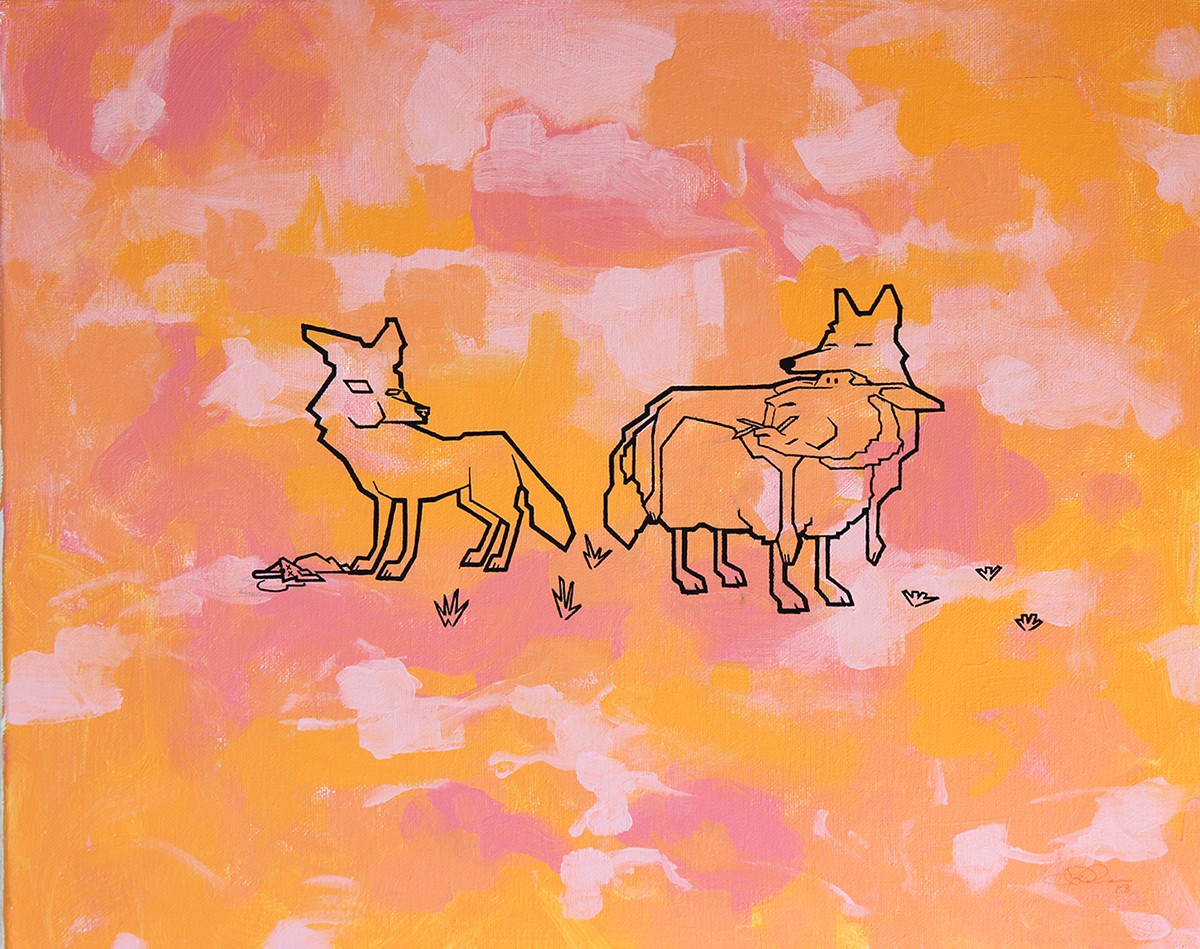
Fitting In, acrylic on canvas, 16 x 20, 2013 by Jonathan Nelson, used with permission.
What craft and career advice do you have for Native artists who might be interested in illustrating books for children? 

Draw, paint, or illustrate what you love. There are so many avenues for every type of art. There are many stories out there that are looking for art, so as long as you have your portfolio to share someone will come along and want to work with you.

For a long time, I tried to cater to a specific style on someone’s project. It didn’t seem to work out, so I stopped trying to copy someone else’s work. I began to draw what I wanted to draw. I like big, flat Chuck Taylors and large hands or hooves on my characters.

I love how the lines from my ballpoint pen aren’t clean, but together you can see a glass filled with water or thick wool or sagebrush.

Sheep in the Landscape No. 3, oil on canvas, by Jonathan Nelson, used with permission.
What books do you have coming up next?

I’m illustrating another children’s book called Hey, Dog (written by Tony Johnston (Charlesbridge, 2019)) at the moment. It’s a boy who tries to befriend a homeless dog. I just finished the sketches and got the okay to “paint” the final art.


I'm creating the art in the same fashion as First Laugh by drawing with a ballpoint pen. I scan the drawings and digitally paint the art in Photoshop.

I’m slowly chipping away at Jonesy II. I have the story written and have drafts and outlines to part 6. Jonesy is overdue, but my work as a creative consultant keeps me busy on graphic & web design and illustration projects. I’m looking forward to these upcoming projects!

Wado, Jonathan, for visiting with me about First Laugh – Welcome Baby!

Cynsational Notes

Jonathan Nelson is a visual artist. He is Diné (Navajo) and born into his mother’s clan, the Towering House Clan (Kiiyaa'áanii), and born for his father’s clan, Mexican Clan (Naakai Dine’é).

Jonathan holds a master’s degree in visual communication from the University of Arizona and specializes as an illustrator, fine artist, and creative consultant.

Born and raised in the Four Corners area of New Mexico, Jonathan began his art experience drawing on wide-ruled paper on the kitchen table at age five. He collected comic books and started tracing Spiderman, X-Men, Hulk, and many others. Elementary tracing evolved into freehand drawings with No. 2 school pencils. His drawing has evolved into a career as a creative professional.

Nowadays, he works in ballpoint pen and paint to showcase modern vast high desert landscapes filled with sheep. The landscapes, and his other works, bring to light the sustaining life of indigenous culture and its on-going struggle in a Eurocentric driven society.

Visit his website to view upcoming events and other works on politics, racism, tribal identity, stereotypes, and environment. Ahéhee'

Traci Sorell covers picture books as well as children's-YA writing, illustration, publishing and other book news from Indigenous authors and illustrators for Cynsations. She is an enrolled citizen of the Cherokee Nation.

We Are Grateful: Otsaliheliga illustrated by Frané Lessac (Charlesbridge Sept. 4, 2018) is her first nonfiction picture book and a 2018 Junior Library Guild Selection. The story, which has received starred reviews from Kirkus and School Library Journal, features a panorama of modern-day Cherokee cultural practices and experiences, presented through the four seasons. It conveys a universal spirit of gratitude common in many cultures.

In fall 2019, her first fiction picture book, At the Mountain’s Base, illustrated by Weshoyot Alvitre will be published by Penguin Random House’s new imprint, Kokila.

Traci is represented by Emily Mitchell of Wernick & Pratt Literary Agency.

Watch a video of author Rose Ann Tahe reading First Laugh, Navajo Baby. 

New Voices: Kaylee Morrison and Nancy Smith on Joshua and The Biggest Fish

| | 0 comments
Nancy stands behind co-author & grandkid, Kaylee.
By Cynthia Leitich Smith
for Cynsations

What an honor and joy it is to welcome debut children's authors, Kaylee Morrison and Nancy Smith, who're also citizens of Muscogee Nation!

Their picture book is Joshua and The Biggest Fish (Doodle and Peck Publishing, 2017). From the promotional copy:

The big fish are way out in the deepest part of the river. Will Joshua find a way to catch a really big fish? Maybe then, the men won't see him as "cepane," or little boy. 

A historical, coming-of-age story, based on true events.

You are a grandmother-granddaughter team. How and why did you two begin writing together? What has that been like?

KM: Growing up I was always interested in writing and my grandmother, who wrote her whole life, encouraged me to follow my talents. The older I got, the more I wanted to learn about my Muscogee (Creek) heritage.

My grandmother suggested co-authoring a book to learn about our rich past and provide a way to bring us closer in my teenage years. The process was long, and a bit tedious at times, but that’s what comes with the territory of wanting our book to be historically accurate.

This involved many trips to the Muscogee tribal complex and talking to multiple people which lead to even meeting new family members.

NS: When my granddaughter, Kaylee, turned 16, she told me she wanted to learn more about her Muscogee Creek heritage. I was so happy to hear that.

So, we drove to the Muscogee tribal complex in Okmulgee, Oklahoma, and met with Buddy Cox at the tribe’s Cultural Preservation office. He shared with us many ideas, but the subject that jumped out at us was “fish kills.”

Writing a children’s book about this part of our Muscogee Creek history and culture seemed like a wonderful project we could do together. Kaylee was in her last two years of high school, and then went away to college, so writing our book was a long journey, but so worth it.

What was the initial inspiration for Joshua and the Biggest Fish, illustrated by Dorothy Shaw (Doodle and Peck Publishing, 2017)?

KM: Initially, we both wanted to gain knowledge of our ancestors' past. Although I have lived in Oklahoma my whole life, I knew very little about the Muscogee Nation and I feel that most Oklahomans are the same way. My little sister was about two at the time and a children’s book felt like a perfect way to teach her and many other children a little piece of Creek history.

NS: All young Creek Indian boys are nicknamed “cepane” (chee-BAH-nee), which in Creek language means “little boy.” Our book evolved as a coming-of-age story about a young Creek boy who longs to be accepted as one of the men, and who does not like being called “cepane.” The book is named after my Muscogee (Creek) grandfather, Joshua.

What was the timeline between spark and publication, and what were the major events along the way?

KM: The idea came about when I was sixteen, and after six years of research and writing it was published in 2017. During all of this I was graduating high school and moving to college, so this also slowed up the process along the way.

We first heard of fish kills from Buddy Cox and we both found them incredibly interesting. We decided to go with it, but literature on fish kills is very slim. My grandmother came up with some creative ways to research history on fish kills that made this book possible.

NS: Our book took a total of six years to complete. This was mostly because we wanted our book to be historically and culturally accurate.

After doing research at the Oklahoma Historical Society (Oklahoma City), I discovered historic photographs of Creek Indians taken at the fish kill in the 1920s. Finding these photos was so exciting, and some are featured in our book. By the second year, the Cultural Preservation office changed managers several times, so that was a hurdle. Finding a publisher was also a challenge.

What were the challenges (emotional, logistical, research, professional) in bringing the book to life?

KM: After finishing the writing portion of the book, I think the biggest struggle was finding a publisher. Being first-time authors in a niche market was hard to sell to publishers.

My grandmother promised me from the very beginning that we would get the book published and I never doubted her; although, it is vexing to be turned down multiple times on something you have worked so hard on.

My grandmother never gave up, even through tough times, to get this book published and I couldn’t have done it without her. I am grateful for her every day.

NS: We took at least 8 to 10 trips to the Creek Nation in Okmulgee to do research, and several trips to the Oklahoma Historical Society. You must be very interested in your project, and very dedicated to work for long periods of time toward completion. One thing that kept me going was wanting to complete the book with my granddaughter, Kaylee.

What do you hope that young readers take away from the story?

KM: I want readers to learn a part of history that few know about and to spark their interest in Indian culture. There are very few Creek Indian children’s books, and I hope this book inspires more to come.

NS: I hope young Muscogee (Creek) readers will feel pride in their culture from our book, and pride in being Creek citizens. I also hope all young readers will enjoy reading about our tribe’s past and learning about our language and culture.

What did Dorothy Shaw's art bring to your book?


With illustrator Dorothy Shaw
KM: The first time I saw Dorothy’s artwork for the book, I was blown away and thrilled that she brought our words to life. The story would not be the same without her craftsmanship.

NS: Dorothy Shaw brought our characters to life in a wonderful and colorful way. Her beautiful illustrations along with the historic photographs provided inspiring images to our readers.

How have you celebrated the book's release and connected it to readers, especially in the Muscogee (Creek) and larger Native community?

With Principal Chief James Floyd & Second Chief Louis Hicks
KM: We have done several book signings and hope to start having school visits soon in the Tulsa County area. The tribe has ordered and even re-ordered the book which is very exciting.

Imagining Creek citizens reading our book is a bit mind-blowing and very encouraging. After reading your own words so many times you start to not even recognize them as words, so it comes to a point where you must stop editing and get it out there or you could spend your whole life on it.

NS: We donated seven books to our tribe’s Head Start schools, to share with their young students. Kaylee also presented our Chief and Second Chief with their own personal copies of our book. “Joshua and the Biggest Fish” is carried at our tribe’s gift shop, and we have also done several book signings. Our Tulsa City-County Library has our book at seven of their library branches. I have personally contacted over 20 outlets, bookstores, etc. to market Joshua and The Biggest Fish.

What can your readers expect from you next?

KM: I currently have something in the very beginning stages that I presume will take me a considerable amount of time to finish. It’s a different genre and different age group but something that has been in the back of my head for a while.

NS: I have started working on a middle-grade historical novel about my tribe, which I’m currently doing research on.

New Voice: Dawn Quigley on Apple in the Middle

| | 0 comments
for Cynthia Leitich Smith's Cynsations

This is a watershed year for the release of Native young adult novels.

From Eric Gansworth’s Give Me Some Truth (Scholastic, 2018), the followup to his If I Ever Get Out of Here (Scholastic, 2013), and Tim Tingle’s Trust Your Name (7th Generation, September 2018), the fourth in his No Name series, to the upcoming Hearts Unbroken by Cynthia Leitich Smith (Candlewick, October 2018), I’m pleased to feature a newcomer to the age market, Dawn Quigley.

Her debut novel, Apple in the Middle (North Dakota State University Press, 2018), features Apple, a teen whose mother, from the Turtle Mountain Band of Chippewa, died due to complications from her birth.

Raised by her white physician father and stepmother in an affluent suburb of the Twin Cities, Apple has never had contact with her mother’s family.

The story focuses on Apple’s experience during an extended summer visit with these unknown relatives on the tribe’s reservation located near the Canadian border in what is now north central North Dakota.

What first inspired you to write for young readers?

As I was writing some poetry I found myself sharing my frustrations of how many non-Native authors were creating books which were stereotypically shedding negative light onto Native culture. Here was my inspiration, my poem, and my call for the Native world to not let others tell our stories for us:

Arise 
I am tired of seeing Indians portrayed as victims in literature.
I am tired of how Natives are dripping with alcoholism in your books.
And I am tired of images of sexually deranged,
violently abused and
educationally-lacking characters. 
Native people, arise!
We have, and are still, climbing the mountain of injustice;
Carrying our history on our back as we tread to the top to see the vision our ancestors told us of.
But, instead of glimpsing at the majestic vista,
Too often we must listen as writers plunge our People back to the desolate valleys again.
But you only show the darkness, shutting out the light of hope, and resilience; condemning the beacon of a better tomorrow to melt away.
We Natives have lived in nightfall, but revel in the sunrise of tomorrow.
We, at times, hibernate for a season, but awake in springtime of life. 
Native people, arise!
Our stories, like of old, must reflect the balance between darkness and light; between the highs and the lows; and between this world and the next.
Our history has been one of
genocide,
tear-wrenching tragedy,
and historical trauma.
This must be remembered. This should be told.
But we also know the beauty of our culture; the history which we hold tight; and the values we pass down seven generations. 
So why, when we only have our imaginations to limit us, do we as Native writers and storytellers allow them to present only our darkness to the world?
Why do continually let
them tell our tales? 
Native people, arise!
Where are the heroic characters in our modern Native fiction?
There are too few Indigenous writers who shine the light on our culture.
But I am greedy. I want more.
Why don’t we write about our success -
Not success as the world may see it, but in our Indian way?
Tell us about your grandmother’s quilts. Tell us why your sister worked two jobs and went to night school for her college degree.
Tell us the time when your grandfather’s teaching touched your life.
Tell us.
Tell us.
Just tell us.
Honoring author Joseph Bruchac during the Native YA Today: Contemporary Indigenous Voices & Heroes for the 21st Century panel at the American Library Association conference. Author Cynthia Leitich Smith, moderator Alia Jones, Joseph Bruchac and Dawn Quigley.

Please describe your pre-publication craft apprenticeship. How did you take your writing from a beginner level to publishable? 


My greatest challenge was that I had no idea how to write a book!

In teaching middle school English and reading for most of my 18 years, I spent countless hours reading YA books for my students to select read-aloud and classroom novels.

I fell in love with reading books that could transform my students. I began writing letters to the editors of our local newspapers, then wrote full commentary essays. I gained a lot of confidence each time something was published.

Next I branched out to poetry. But to write a book, this was the challenge. I took a few courses at a local writer’s loft on how to sell and promote books, but not on the actual task of writing.

I did read only one book on it: Stephen King’s On Writing (Scribner, 2000). That book, and reading up to 10 books a month, were my teachers.

I would use favorite sections of a book to learn how the author crafted dialogue, the climatic parts, etc. Then I wrote roughly two pages a day for some time until I had a finished book! I didn’t outline my story at all, and this is something I will do in the future: begin with a rough frame.

What were the best and worst moments of your publishing journey?

The best moment was when I actually finished the book! I felt like a five-year-old wanting to run out and say, “Look, Ma, I wrote a book!”

Then the down side was trying to learn how to pitch and query editors and agents for my Apple in the Middle. I got many “bites” and asks for partials and fulls and also rejects, but it was one editor from North Dakota State University Press who made my writing career when the first line in her letter back to me was: "I love Apple. I love everything about her world."

Suzzanne Kelly loved my Native coming-of-age book, and this, so far, has been another great moment. My book has just come out, so I’m doing readings, signings, et cetera. I know I’m only beginning!

Rolling hills of the Turtle Mountain Band of Ojibwe reservation in North Dakota.
As a member of a community under-represented in youth literature, what did your diverse perspective bring to your story? 

Turtle Mountain rose
I taught in K-12 grades for over 18 years, and it was challenging at times to find books and materials that reflected Native people respectfully.

As a Native teacher, I wanted to show the positive aspects of our culture. I knew that I have lived and seen these beautiful Native aspects and began to educate myself and my peers that there are books out there, but we all need to put in the effort to find, read and evaluate them.

I began this book because of a beckoning voice I kept hearing: Tell them the stories.

My first instinct was to push it away. How could I write a book? Who was I? But I felt this book was to be a legacy for my children to hear about my Turtle Mountain grandparents and what they taught me-and are still teaching me today even though their footprints are no longer on this Earth, but in my soul. And like many Native people who are storytellers, I knew that the best way to share history and life lesson is through the telling of tales.

As I was in the middle of the book, I started to wonder if this was meant to be more than just a family tale, but instead a way to let non-Native people peer through the keyhole to get a glimpse into our world. A world that is a beautiful one, but also a world that is many times misunderstood.

Cynsational Notes

Dawn Quigley, enrolled member of the Turtle Mountain Band of Ojibwe, North Dakota, is an assistant professor in the Education Department at St. Catherine University in St. Paul, Minnesota.

Her website offers support for educators in finding, evaluating and implementing Native American curriculum content from an indigenous perspective.

In addition to her coming-of-age Young Adult novel, Apple in the Middle, Dawn has over 25 published articles and poems, in mainstream magazines, academic journals and newspapers, including American Indian Quarterly, Yellow Medicine Review: A Journal of Indigenous Literature, Art and Thought, Indian Country Today, Hollywood and Vine magazine, and the Minneapolis Star Tribune.

She was awarded the St. Catherine University Denny Prize Award for Distinction in Writing and has been a finalist in both the Minnesota Loft Literary Center's Emerging Writer award and its Mentor Series. Dawn lives in the metro area in Minnesota with her husband and two girls.

Traci Sorell covers picture books as well as children's-YA writing, illustration, publishing and other book news from Indigenous authors and illustrators for Cynsations. She is an enrolled citizen of the Cherokee Nation.

Her first nonfiction picture book, We Are Grateful: Otsaliheliga illustrated by Frané Lessac (Charlesbridge Sept. 4, 2018) features a panorama of modern-day Cherokee cultural practices and experiences, presented through the four seasons. It conveys a universal spirit of gratitude common in many cultures.

In fall 2019, her first fiction picture book, At the Mountain’s Base, illustrated by Weshoyot Alvitre will be published by Penguin Random House’s new imprint, Kokila.

Traci is represented by Emily Mitchell of Wernick & Pratt Literary Agency.

New Voice: Traci Sorell on We Are Grateful: Otsaliheliga

| | 0 comments
Traci & Frane in Tahlequah (Cherokee Nation Capital), June 2017
By Cynthia Leitich Smith
for Cynsations

Traci Sorell is the debut author of We Are Grateful: Otsaliheliga, illustrated by Frané Lessac (Charlesbridge, 2018). From the promotional copy:

Otsaliheliga (oh-jah-LEE-hay-lee-gah) is a word that Cherokee people use to express gratitude. 

Beginning in the fall with the Cherokee New Year and ending in summer, follow a full Cherokee year of celebrations and experiences. 

...this nonfiction look at one group of Native Americans is appended with a glossary and the complete Cherokee syllabary, originally created by Sequoyah.

What first led you to begin writing for young readers?

I decided to start writing for children when my son was four. I had collected picture books since my undergraduate days, particularly those featuring Native Nations. Having cycled through my books and those at my local library, I had difficulty finding any trade-published contemporary picture books featuring Cherokee children to read to my young son.

My tribe, the Cherokee Nation, is the largest in the U.S. with over 350,000 enrolled citizens. How could I not find a picture book about our present-day life and culture? It made me think that other Cherokee parents, aunts, uncles and grandparents must be facing a similar problem.

I contacted a friend from graduate school who I knew had trade published books for children for advice. I attended my first SCBWI conference about writing for children in October 2013 and decided to work toward a full-time career as an author in 2015.

For me, the biggest challenge was making sure I understood the craft, so I could execute the writing. I’ve written in many different formats previously, but I’ll admit writing for children is more difficult than writing a legal brief or code.

Writing sparse, lyrical text for a picture book to capture and hold the attention of discriminating younger readers is a challenge. They will put down the book, walk away, and turn their attention elsewhere when the story starts to drag – either from the words or the art. They have no sense of “I should finish this, so I’ll trudge on through it.” If they aren’t interested, it’s over.

Knowing that invigorates me to write at a higher level, knowing every word has to be precise to evoke the emotion, convey the information or provoke the question that I want reader to experience, understand or ask.

Thankfully, I have wonderful people – fellow authors, my agent and editors - who keep me on track if I stray from that.

Please share with us the story of your literary apprenticeship. How did you master the craft of picture book writing?

I read a lot of picture books written in the last three years to learn what the market wanted. That helped me shape and edit my own voice to write sparse, lyrical texts that sell in the marketplace.

I benefitted from reading Ann Whitford Paul’s Writing Picture Books (Writer's Digest, 2009) and connecting with published authors in my local KS-MO chapter of SCBWI who provided solid critiques and guided to me beneficial workshops to further develop my voice and craft.

From there, I expanded my network to connecting with other authors via social media, including you!

Congratulations on the release of We Are Grateful: Otsaliheliga, illustrated by Frané Lessac (Charlesbridge, 2018)! What was the timeline between your creative inspiration and publication, and what were the major events along the way?

Traci & Charlesbridge editor Karen Boss
I wrote We Are Grateful: Otsaliheliga in November 2015 because I won a free Skype critique for a nonfiction picture book from award-winning author Suzanne Slade through Picture Book Builders and had nothing to submit!

After revising based on her direction, I submitted the second draft with a few minor tweaks to some wording to ten publishers a month later. Then I sold it to Charlesbridge through the slush pile (unsolicited/unagented) in March 2016.

After Charlesbridge bought it, my editor Karen Boss did not have any substantial changes. She moved some text around based on the design layout that she wanted for the book, but otherwise the text was finalized quickly.

Karen asked if I had any illustrators in mind. I gave her a list of Native and non-Native illustrators. Frané was on that list. I was so overjoyed when she was selected.

The whole debut process has gone so smoothly, and I’m so thankful to work with such a wonderful team of people.

What did Frané Lessac’s art bring to your text? To what extent did you work together?

Her artwork takes the text to a different level. The detail, color, humor, and vivaciousness she creates in the book humbles me. I am in awe of what she envisioned and subsequently painted for all readers to enjoy.

Initially I sent her links to a variety of webpages and videos with information about the Cherokee Nation, its citizens, culture, and history to help her start her research.

Unless you’ve been to the Cherokee Nation (in the northeast corner of Oklahoma), you don’t have a feel for the people, landscape, flora and fauna. It’s not like anywhere else I’ve ever been in all my years of living, studying and traveling elsewhere on this continent and abroad.

Even though she didn’t receive the research travel grant she applied for, she traveled to the Cherokee Nation from Western Australia last summer anyway. So we actually got to meet and spend a few days together in late June 2017.

I introduced her to fellow Cherokee citizens who work in our cultural and museum programs. She shared her rough sketches and sought their input to make sure she had details correct.

We traveled with Will Chavez, the Assistant Editor of the Cherokee Phoenix, our tribal newspaper, where he showed her a number of historic sites, types of foliage and animals common in the area. He also provided photos from his extensive collection for her to consult later as she created the final artwork. My brother, a trained chef, prepared bean bread and hominy soup (both mentioned in the book) for her to sample.

So I like to think she enjoyed the hospitality that Cherokee people are known for, while also working to gather the information she needed to tell her part of the story.

Tell us more about how you decided to weave Cherokee words into the story and your approach on what to include in the back matter.

For me, this was integral. I was elated when Charlesbridge wanted the book because they had published the picture book, Itse Selu: Cherokee Harvest Festival (1994), featuring Cherokee words unitalicized throughout the text. It had served as an early model for me as a writer that including my tribe’s language would be welcome.


We decided to add the Cherokee syllabary next to the English phonetics at the bottom of each page where a Cherokee word appears because that’s how Cherokee people actually read and speak the language. They are not learning and speaking it from the English phonetics.

Regarding the back matter, I knew I needed to provide a little more context to some of the text and artwork. Given how little people know about contemporary Cherokee life, adding the Definitions section allowed me to amplify any reader’s understanding of what they read and saw on the page.

The Author’s Note explains my reasons for writing this nonfiction picture book.

Including the Cherokee syllabary as it is currently taught in the Cherokee Nation helps readers to know that this language continues to be spoken and is the foundation of our cultural identity as Cherokee people.

As a Native author, how does that identity element inform your writing and your role in the children’s-YA book community?

It’s the foundation of my voice and everything I write. I can’t separate it. My educational and professional backgrounds have also been focused on Native Nations, their citizens, culture, history, law and policies and how those have been impacted under the colonial regime of the United States.

When I research primary and secondary sources or read children’s literature for example, I notice what voices and experiences are included, who is left out and how that shapes the narrative and information the reader receives.

Right now, I feel like I have three main roles in the children’s-YA book community besides getting my writing out in the world.

First, I want to bring additional awareness to invisibility of Native people in the text as well as omissions of accuracy, so other writers recognize the importance of doing the work to get it right. We all are responsible for this.

Second, I want to recruit other Native creators – writers and artists – to create great works for children. You have been extremely supportive of me and other Native creators coming into the field, and I strive to emulate that. We have amazing storytellers in word and art in our Native Nations. I want children to know about and experience the stories those creators have to share. It’s imperative to recruit, educate and encourage others to make that happen.

Third, covering Native/First Nations authors, illustrators, and publishers for your Cynsations blog allows greater visibility for the craft of Native creators in the industry. I enjoy showcasing what their stories and artwork are offering for children and teens in this field. I appreciate you asking me to assist in this way.

What advice do you have for new Native or First Nations writers, starting out?

We Are Grateful poster
I believe it’s important to read broadly across the various genres of children’s literature and determine which one resonates most with your voice as a writer. I gravitated to writing picture books first because I have always loved poetry, sparse use of language, and beautiful artwork. Any writer new to this field needs to make that same determination for themselves.

Then, I recommend studying books published within the last three years within that chosen genre. You’ll be expected to know and state what are comparable titles when you submit your manuscript for consideration. So anticipate that and be prepared.

Next, try to find fellow writers in your genre at the level just above your skill set to read and critique your work. This will pay dividends because your writing will be elevated more quickly with trained eyes providing feedback.

It is extremely helpful if some of these writers are also Native creators. In my experience, finding fellow Native creators will be a huge boost of encouragement and support as you embark on this journey.

What can your readers look forward to next?

Since Charlesbridge bought We Are Grateful: Otsaliheliga, I’ve sold two other picture books, At The Mountain’s Base, illustrated by Weshoyot Alvitre (Kokila, Fall 2019) and Powwow Day illustrated by Marlena Myles (Charlesbridge, Spring 2020). Both are fiction. I’m looking forward to those being out in the world alongside We Are Grateful: Otsaliheliga. I also have two picture book biographies, several other fictional picture books, a novel-in-verse and some poems in progress.

Cynsations Return & Author Update: Cynthia Leitich Smith on Writing, New Releases, Native Voices & Allies

| | 0 comments
Learn more about Cynthia Leitich Smith.
By Traci Sorell
for Cynthia Leitich Smith's Cynsations

As an New York Times bestselling author and the creator of Cynsations blog, Cynthia is well known to many. But after reading her upcoming YA novel, Hearts Unbroken (Candlewick, Oct. 9), this summer, I believe readers gain more insight into her earlier years.

The novel draws in part on her experience as a Muscogee (Creek) teen growing up in the suburbs of Kansas City and as a reporter and, later, editor-in-chief on her high school newspaper.

The fictional, contemporary story follows Louise, a senior forced to reconcile how bigotry and racism are coming to a head in her community through her various roles as a tribal citizen, sister, student, reporter, friend and, most definitely, girlfriend.

Cynthia, I welcome you to Cynsations, your own wonderful creation!

From the promotional copy:

When Louise Wolfe’s first real boyfriend mocks and disrespects Native people in front of her, she breaks things off immediately and dumps him. It’s her senior year, anyway, and she’d rather spend her time on her family and friends and working on the school newspaper.

The editors pair her up with Joey Kairouz, the ambitious new photojournalist, and in no time the paper’s staff find themselves with a major story to cover: the school musical director’s inclusive approach to casting “The Wizard of Oz” has been provoking backlash in their mostly white, middle-class Kansas town.

From the newly formed “Parents Against Revisionist Theater” to anonymous threats, long-held prejudices are being laid bare and hostilities are spreading against teachers, parents, and students—especially the cast members at the center of the controversy, including Lou’s little brother, who’s playing the Tin Man.

As tensions heighten at school, so does a romance between Lou and Joey—but as she’s learned, “dating while Native” can be difficult. In trying to protect her own heart, will Lou break Joey’s?


Pre-order a signed copy from BookPeople or order at your local store & request a signed bookplate & goodies!
Let's start with the genre – you've crafted a contemporary, realistic young adult novel whereas your more recent novels have been YA fantasy. What prompted the return to a novel with a contemporary Native American teen and her family as the focus? 

I have this theory that where there are secrets, lies or regrets, there are stories. Think about it, in each case, there are stakes, there is nuance and competing interests. Conflict and reversals.

Hearts Unbroken began with a regret, as a novel-length apology to a high school boyfriend. I was an awkward teen (hey, I’m an awkward adult!). When I’m nervous or exhausted, I still babble a bit even though I can absolutely rock a podium with proper preparation.

Bottom line, I said the wrong thing, and I was sorry for decades. There’s a story in that and it’s not all in the book, which is only loosely inspired by what really happened.

How would you describe the story?

It’s a love story wrapped around a school-journalism story, written in an Indigenous style and sensibility. Or at least a hybrid style with strong Indigenous elements.

Enter to win 1 of 10 hardcovers!
The novel is thematically about speech, nodding to journalistic speech, religious speech, political speech, interpersonal speech, hate speech and microaggressions.

Or, put another way, it's about speech, its blessings and its costs.

Early Native readers have mentioned to me that they see it as about empowering cultural voice, especially given the inclusion of Indigenous language in a daily-life reclamation context.

Big picture, the plot is infuriating and funny and representative and romantic. It’s also a little geeky. All of my stories are at least a little geeky. There’s also terrific kissing.

The narrative goes all in, fully submerging the reader in a Native teen perspective and suburban experience. The depiction of the family relationships is central. Meanwhile, the subplot, centered on the protagonist's brother, (hopefully) offers more mainstream appeal.

Why did you decide to focus your protagonist on high-school journalism?

Again, personal experience. I was the editor of my high school newspaper and went on to major in news/editorial at the White School of Journalism at the University of Kansas. As a student at The University of Michigan Law School, the First Amendment was a major focus of my studies. In my third and final year, I did an independent study on the right to speak (and the right not to) with Professor Lee C. Bollinger, who's now the president of Columbia University in New York.

No, I didn’t set out to write Hearts Unbroken because news journalists are unfairly under attack right now, but I’m glad it’ll be out there for teens today. I hope it encourages at least a few readers to consider a career in reporting, editing, photo and/or videography.

You are always encouraging Native writers entering the industry. What craft and career advice do you have for those just starting out on this journey?

Get in touch with Native children’s-YA authors who’re agented and/or actively publishing. Read what’s already out there by members of our intertribal community. You'll be able to gain an up-to-date, in-depth overview at Debbie Reese’s blog, American Indians in Children’s Literature.

Native authors at Kweli, 2016
Visit your local SCBWI regional chapter – attend a conference or workshop or both. They vary from place to place. Hopefully, it’ll be a fit. If not, look for another one that's driveable.

Make an effort to attend Kweli: The Color of Children's Literature Conference.

Embrace the study of craft. Seriously, commit. Enroll in workshops – there are a variety on and offline at various price points. Find a solid critique group or partner.

If you want to get an MFA in writing for young readers, write me and we'll discuss whether it's the right choice for you. See also my writer resources.

For those who’re allies, how can they support Native voices?

Foremost, be respectful of Native people and cultures in working with young readers. Assume that there are Native kids in your classrooms and communities. They’re everywhere, and so are their peers, who interact with them based on what they learn from the larger society, from you.

Set aside everything you picked up from Hollywood. Treat the political noise out of Washington, D.C. with a hefty amount of suspicion. Forget those construction-paper headdresses you made in first grade for Thanksgiving.

Chris Evans, Hemsworth & Pratt 
Are you used to thinking of yourself as the hero of the story? We routinely see the underrepresentation of some folks but also the overrepresentation of others.

Three of the Marvel superheroes in the last Avengers movie were played by white dudes named Chris. Chris Pratt as Star-Lord, Chris Evans as Captain America, and Chris Hemsworth as Thor.* And, hey, I enjoyed all of their performances. But no way around it, that's seriously hefty representation.

Meanwhile, can you name any three on-screen Native girl or women characters from your entire history as a moviegoer? (Bonus points if they're not animated.)

All of which is to say, when it comes to Native people, you may need to gut check your instinct to cast yourself as the savior.

Understand that you don’t know the history and are probably underestimating the complexity, not only regarding Native cultures but also Indigenous governmental structures and literary forms. The oral tradition is vital, but we have our own relationship to the written word, too.

What else? We’re a growing but small creative community with precious few gatekeepers of our own. Give us a chance to speak and not only about Native and diverse literature, though when we do talk about all that, listen carefully and reflect deeply.

Signal boost our new and existing releases. Advocate for our inclusion throughout the curriculum and book-events circuit, and integrate our titles not only in your Native Heritage Month celebrations but all year long.

Have you ever read a YA novel by a Native woman? Check out Apple in the Middle by debut author Dawn Quigley (North Dakota State University Press, 2018). In no particular order, also be sure to read books by Joseph Bruchac, Tim Tingle, Traci Sorell, Carole Lindstrom, Art Coulson, David A. Robertson, Cheryl Savageau, Lisa Charleyboy, Lee FrancisMonique Gray Smith, Erika T. Wurth, Jenny Kay Dupuis, Richard Van Camp, Arigon StarrKate Hart, Eric Gansworth, Louise ErdrichCherie Dimaline, Daniel Vandever…. I could go on and on, and there are more writers and illustrators on the horizon. See my teacher and librarian resources.

* Just to geek out: Chris Evans also played The Human Torch. Additional white guys named Chris who played superheroes include: Christopher Reeve as Superman; Christian Bale as Batman; Chris O'Donnell as Robin; and I'm giving partial credit to Chris Pine, as Captain Kirk because he also played Steve Trevor in "Wonder Woman" and appeared in "A Wrinkle in Time."

Is there anything you’d like to say more broadly to writers from any underrepresented group?

In Memory: Nancy Garden
Offer private and public support to one another, especially those of you who’re bigger, more established names or members of groups with a stronger presence.

Years ago, I wrote a Horn Book article about Native humor and storytelling, and Nancy Garden sent in a letter to the editor in support. She was a very early, important voice in the LGBTQ writimg community and understood what it’s like when your numbers are small.

The fact that she took the time and made the effort? It meant the world to me. Still does.

You’ve been a leader in the conversation around diversity during both its ebbs and flows. What aren’t we talking about that we should be? 

From a writing craft perspective, we should focus more on secondary characters and intersecting subject matter. Every single writer must write across identity elements in those contexts. It’s not all about protagonists and the nonfiction focal topics.

More broadly, those of us in children's-YA writing need to wrap our minds around the fact that we’ve been defaulting to the same white and male storytelling constructs for generations. More than that, those of us who're writing teachers have been largely insisting upon them. Meanwhile, content-wise, let's not settle for bite-sized nuggets of representation, tailored to mainstream comfort and expectations. Let's embrace diversity for real.

This fall marks the paperback release of Feral Pride (Candlewick, 2015, 2018). Could you tell us a little about that story?

Sure! It’s the cap to the Feral trilogy and crosses over its heroes with those from the Tantalize series, which is set in the same universe.

The governor of Texas has been kidnapped by demon snakes and furry hominids (kind of like Bigfoot) and the scoundrels have blamed our heroes, who’re shapeshifters, for the crime.

This is a fantastical construct in which shapeshifters battle bigotry and oppression parallel to what marginalized groups experience in our real world. So, yes, it’s funny and romantic and action-packed and super geeky, but it also speaks through metaphor to ongoing real-world dynamics.

Why did you first launch Cynsations, and how has it evolved over the years?

As I mentioned above, I’m a recovering journalist, and I always wanted to cover good news.

Pre-order Feral Pride in paperback.
(When writers are thinking about where their voice fits into the conversation of books, it’s worthwhile to consider what they enjoy doing and where their strengths lie.)

I entered the field at a time of low morale in the creative community. Publishers weren’t taking many chances on new voices. Celebrity books were all the rage. Madonna said on late-night television that she wrote a children’s book because there weren’t any good ones.

Meanwhile, I was trying to raise awareness of contemporary Native children’s books in a society that had decided Native people were all extinct. (I'm told that’s the answer Texas school children are supposed to provide on standardized tests to any questions asked about Native people: Extinct.)

So, I figured I’d get really 21rst century with it. Show by example that Native people have a present and future.

So, I fired up Cynsations to illuminate new voices, mid-career authors, living legends. Writing by authors and illustrators from underrepresented communities. The business of publishing. The writing life. Craft. The idea was to reach out to writers in a more-than-a-guidebook kind of way, in an encouraging and ongoing conversation.

What do you have coming up next?

My immediate focus is on middle grade projects. I’m especially excited about an anthology of stories by new and established Native voices, set around a contemporary powwow. As for my current novel writing, we're talking middle grade speculative fiction. I also have another middle-grade realistic short story coming out in another anthology and a couple of poems that will be featured in picture books. Meanwhile, I'm putting thought into what my next project for teens might be.

Beyond that, I’m committed to supporting and signal boosting other voices – underrepresented and/or new and/or reinventing and/or long-established voices, too.

So, write on, Cynsational readers! I believe in you.

Cynsational Notes

Look for Cynthia's upcoming YA release, Hearts Unbroken (Candlewick, Oct. 9). If you'd like a signed copy, you can pre-order it from her local independent bookstore, BookPeople, of Austin, Texas. Or, if you've already pre-ordered, request a signed bookplate and goodies. The paperback of Feral Pride (Book 3 in the Feral trilogy)(Candlewick, Oct. 2) is available for pre-order, too.

Giveaways! Are you a high school teacher, YA librarian or Native teen group leader? Check out this classroom-set ARC giveaway of Hearts Unbroken on Twitter! Are you a YA reader? Enter to win one of 10 hardcover copies of Hearts Unbroken from YA and Kids! Book Central.

Traci Sorell covers picture books as well as children's-YA writing, illustration, publishing and other book news from Indigenous authors and illustrators for Cynsations. She is an enrolled citizen of the Cherokee Nation.

We Are Grateful: Otsaliheliga illustrated by Frané Lessac (Charlesbridge Sept. 4, 2018) is her first nonfiction picture book and a 2018 Junior Library Guild Selection. The story, which has received starred reviews from Kirkus and School Library Journal, features a panorama of modern-day Cherokee cultural practices and experiences, presented through the four seasons. It conveys a universal spirit of gratitude common in many cultures.

In fall 2019, her first fiction picture book, At the Mountain’s Base, illustrated by Weshoyot Alvitre will be published by Penguin Random House’s new imprint, Kokila.

Traci is represented by Emily Mitchell of Wernick & Pratt Literary Agency.

See also an interview with Traci from Picture Book Builders. Peek: "First, it needed to be colorful because it’s a four seasons book—so bright and not muted was what I pictured in mind. Second, the illustrations must be culturally accurate. I got my two criteria met and so much more!"

Cynsational Return

From Cynthia Leitich Smith

Sunset at Vermont College of Fine Arts.
Welcome back to Cynsations! We hope you had a wonderful summer. My highlights included teaching at the residency of the MFA program in Writing for Children and Young Adults at Vermont College of Fine Arts in Montpelier and speaking at the annual convention of the American Library Association in New Orleans. Right now, I'm at LoonSong: A Writer's Retreat in Cook, Minnesota.

Here on the blog, we'll once again be hosting insights from writers at every stage of their creative journey. We'll look at books that cross borders, publishing as an industry and new releases. We'll consider various aspects of a writing life.

This semester, we're moving to more flexibility between four- and five-day posting weeks. But we're sure you'll still find plenty to read and reflect on.

Thank you to Cynterns Gayleen Rabakukk and Robin Galbraith for their ongoing efforts.

Thanks to all for returning to Cynsations. We hope you'll find fruitful inspiration and information in the posts to come.

Author Interview: Tim Tingle, Choctaw Storyteller & Author

| | 0 comments
Tim Tingle (right) with his son, Dr. Jacob Tingle,
photo courtesy Oklahoma Center for the Book.
By Traci Sorell
for Cynthia Leitich Smith's Cynsations

On April 7, 2018, author Tim Tingle received the Arrell Gibson Lifetime Achievement Award.

Named in honor of an author who served as Oklahoma Center for the Book's first president, the award is presented annually  for a body of work contributing to Oklahoma's literary heritage.

Congratulations, Tim! What a wonderful honor. Tell me what it was like getting that news. 

I have attended several Oklahoma Center for the Book Award ceremonies, as Crossing Bok Chitto (Cinco Puntos, 2006) won Best Children's Book, and Walking the Choctaw Road (Cinco Punto, 2005) and House of Purple Cedar (Cinco Punto, 2014) were finalists in their categories.

I was there when a dear and admired friend of mine, Rilla Askew, received the Lifetime Achievement Award.

When I received the phone call letting me know I was selected as the 2018 recipient, my first response was disbelief. I had studied most of the previous American Indian recipients in lit courses at grad school at the University of Oklahoma (OU). "I am so far from that level," I thought to myself.

When I hung up the phone I decided that I still have maybe 15 years of writing ahead of me (I'll be 70 years old in November), and I will dedicate the remainder of my life to earning this award—the award now hanging next to my fireplace in Canyon Lake, Texas.

I called my son first, Dr. Jacob Tingle of Trinity University. I had been asked to select someone to introduce me at the awards ceremony, and Jacob agreed.

Roadrunner Press, my publisher of the How I Became A Ghost series (2015-), purchased a table of eight for my family and friends. I invited Dr. Geary Hobson, a Cherokee poet and my lead professor during my OU days, and his wife, Dr. Barbara Hobson, former Chair of Native American Studies there.

My son told of riding with me one summer in the Maxwell House Coffee truck, as I repaired coffee machines at small town restaurants in the Texas Hill Country. He shared anecdotes I would never have remembered, and how my work ethic and respect for working people was evident in all that I did. During my acceptance speech, I told of Dr. Hobson, and how without his encouragement I would never have written a single book. His wife later told me he sat at the table and cried.

The circle of friends that evening will always remain very special to me, and among them was Gene Burks of Dallas. He spotted Doc Moore and I telling stories at Six Flags Over Texas in 1994 and invited me to share Choctaw stories in the Garland school district, where he was on the school board. That was the beginning of my full-time storytelling career, and eventually lead to the publication of Walking the Choctaw Road (Cinco Puntos, 2005).

I closed my speech by singing "Shilombish Holitopama, Amazing Grace" in Choctaw, and George Nigh, a former governor of Oklahoma and the evening's emcee, sang in English from his chair on the stage behind me.

Governor George Nigh with Tim at Oklahoma Book Awards,
photo courtesy Oklahoma Center for the Book.
Which came first? Your work as a storyteller or as a writer? What have you done to hone both crafts? 

I began writing when I was in the second grade at South Houston Elementary School. I had read several Hardy Boys books (1927-2005) and listened to my Uncle Kenneth tell backyard stories about my Choctaw Mawmaw's tough life growing up in the racial quandary of 1890s Oklahoma.

My teacher, Mrs. Palmer, tapped her knuckles on the desk and said, "Everyone listen. Free time, so pull out your Big Chief tablets, your crayolas, and draw. I will be grading tests."

Photo by Lisa Reed
I decided to go with "free time" rather than crayolas, and I began a screenplay for "Zorro" (1957-1959), my favorite television show. Mrs. Palmer spotted me, snatched the unfinished first page, and tossed it in the trash. "Never do that again, not in my class," she said. So I didn't.

For forty years, I kept my writing to myself and told oral stories. But before that, in my mid-twenties, I went from college basketball player to modern dance soloist with the Michael Sokoloff Ensemble, a touring group back when the National Endowment for the Arts was well-funded.

As I moved with the rhythm when I danced, I now write with my headset and music. For the past decade my soundtrack has been The Chieftains, an Irish folkish group.

Doc Moore and I co-wrote three Texas ghost story books, published by Texas Tech University Press, before I decided to focus on Choctaw history and stories, with fictional twists and turns.

Most of the stories in my first book, Walking the Choctaw Road, were originally oral stories, performed at festivals and schools throughout the United States, Canada, Germany, Ireland, and Mexico.

At the age of 50, I realized my oral stories would be buried with me someday, so I took a hiatus from performing and attended graduate school in Native American Studies at the University of Oklahoma, where I earned an M.A. degree and completed Walking The Choctaw Road.

I feel that the spoken word experience gives strength to the first person narrative, and use it often in my writing.
Tim at Sequoyah's Cabin with Fort Smith high school teachers
who were teaching House of Purple Cedar in their classrooms. 
You have two more books out this year in the No Name young adult series, No More No Name (2017), A Name Earned (2018) and Trust Your Name (2018)(7th Generation). What gave rise to the character of Bobby Byington, a Choctaw basketball player? 

See Kirkus Reviews
When my editor called and said she very much enjoyed the premise to "No Name,” the original book in the series, but "the idea of a boy digging a hole in his backyard and living in it when his alcoholic father was home—that's so unrealistic."

I took a deep breath before answering.

"If my big brother were still alive, he could tell you. That's how we survived. We dug a hole in the field behind our house and dragged an old junkyard door over it. My dad never found our hiding place."

My brother played basketball for the University of Houston Cougars, along with Elvin Hayes and Clyde Drexler, and I played junior college basketball on a scholarship.

We were also warned by my grandmother never to tell any of our friends we were Choctaw, for fear of what might someday happen.

The racism and bullying in the No Name series were always just around the corner of my youth.

The long-awaited sequel to your award-winning middle grade novel, How I Became A Ghost, is finally here. Any pressure in writing When A Ghost Talks, Listen (Roadrunner, Aug. 7, 2018), knowing how well the first one was received? What challenged you the most in writing this second book? Will there be more books in this series? 

I so love the characters of this series that popping on my headset, flipping the music button, and entering the world of shape-shifting panthers, rattlesnakes and soaring ghosts was and is a joy.

Pre-order When a Ghost Talks, Listen 
I know rattlesnake Stella. She is based on an elderly Choctaw friend of mine, Stella Long, who gave me permission to use her name. I later told her she was on the cover of the book, and imagine her surprise when she saw her "rattlesnake-self" grinning back at her.

I have maybe eight shelves of Choctaw and Southeastern Indian books surrounding my writing desk, fiction and nonfiction both.

I spent a few years researching the facts behind book two, including two trips to the Library of Congress in Washington, D.C.

The questionable death of Chief and United States Army General Pushmataha was a strong inspiration in the writing process. I still feel him standing over me, watching, nodding, and wiping away a few tears.

I do plan on continuing the How I Became A Ghost series, with a World War I Choctaw Codetalker book (in book two, we learn that Choctaw ghosts can time-travel) and a book moving back and forth from the Trail of Tears to the Irish Famine in the future.

As I learned during a trip to Ireland a few years ago, "historical" accounts of the causes and death tolls related to the Famine are as false as most popular Trail of Tears narratives.

I hope to keep Isaac alive (as alive as a ghost can be) for at least another decade, accompanied by his bilingual dog, Jumper.

Tim speaking at the Smithsonian
Any writing for children and teens that we’ll see from you in 2019 or beyond that you’d like to share?

Yes, I'll have two new book releases in 2019.

From Lee & Low comes Stone River Crossing, a 250-page middle grade novel based on my picture book, Crossing Bok Chitto: A Choctaw Tale of Friendship and Freedom (Cinco Puntos, 2008). The narrative follows the family of escapees from a pre-Civil War plantation. As they are rescued by nearby Choctaws, the battle ensues over "ownership."

What the western world labels as magic realism, but what we Choctaws recognize as everyday life abounds.

Also, the first book in a series from Scholastic Press arrives in 2019, Timmy the Choctaw Detective and the Graveyard Treasure, a middle grade novel of a twelve-year-old youngster, our narrator, who sees himself as the best detective in town.

The lead detective of the local police force gives Timmy his first cell phone for his birthday, and they become partners in crime solving. Timmy’s neighbor is Doc, an elderly man living by himself with advancing dementia, accompanied by acute observational skills.

Timmy discovers that Doc's maid is also an aide at a nearby nursing home, and part of a gang that steals only from the elderly. And where does the gang bury their ill-begotten loot? In the centuries-old mausoleum of the town cemetery. And when does he make this discovery? After midnight, of course, with a gang member looking over his shoulder.

Wow, Tim, you’ve already got me looking forward to 2019 and these great books you’ve written. We appreciate the preview.

Cynsational Notes

Tim Tingle is an award-winning author, much sought-after storyteller, and an enrolled member of the Choctaw Nation of Oklahoma.

His great-great grandfather, John Carnes, walked the Trail of Tears in 1835 and passed-down memories of this family epic that fueled Tim’s early interest in writing and storytelling.

He has twice been honored with the American Indian Youth Literature Award, for How I Became a Ghost in 2014, and again in 2016 for House of Purple Cedar (Cinco Puntos, 2013).

He is represented by Andrea Cascardi of the Transatlantic Agency.

Traci Sorell covers picture books as well as children's-YA writing, illustration, publishing and other book news from Indigenous authors and illustrators for Cynsations. She is an enrolled citizen of the Cherokee Nation.

Her first nonfiction picture book, We Are Grateful: Otsaliheliga illustrated by Frané Lessac, will be published by Charlesbridge on Sept. 4, 2018. The story features a panorama of modern-day Cherokee cultural practices and experiences, presented through the four seasons. It conveys a universal spirit of gratitude common in many cultures.

In fall 2019, her first fiction picture book, At the Mountain’s Base, illustrated by Weshoyot Alvitre will be published by Penguin Random House’s new imprint, Kokila.

Traci is represented by Emily Mitchell of Wernick & Pratt Literary Agency.