Showing posts with label 1940s. Show all posts

Who was GM Co?

| | 0 comments
Black cat driving a Jack O'Lantern car from a vintage halloween candy container circa 1940s.

A well-known admirer of vintage Halloween currently credits a series of candy containers, pull-toys and rockers (constructed of paper-laminated cardboard) to General Merchandise Company of the 1940s-1950s. Determination appears based on the bottom abbreviation of G.M. CO., but what is the historical record of this company and of its product output? 

As of this writing, I find no iteration of a plausible General Merchandise Company referred to as G.M. Co. (for example  - The Treasury that was at one time named General Merchandise Company has no evident markings of G.M. Co. on its catalogs). As well, other than a few known series of holiday containers (for Easter, Valentines Day, Halloween see below marked G.M. Co), I find no other products via an internet search. Note that research is made difficult because general merchandise is a common term of business categorization such as dry goods; many businesses could describe themselves as a general merchandise company.

Halloween slot-and-tab box illustration of green-skinned witch flying through the night sky.

Witch driving a show, witch at a cauldron, cat driving a pumpkin, and black cat sailor with owl - circa 1940s.

Above are five of the six slot-and-tab candy containers that are known to exist in this series. This series is marked G.M. CO. HRS-A thru F (Not shown above is a skeleton with a JOL in a pull cart (A). These are said to be from the 1940s.

Large item series of pull toys dated to the 1940s by the GM Co. with flowing brush stroke illustrations.

The above item is from a small series of large-sized pull toys. This one is marked RH-6D-GM.  A skeleton with a JOL in a wheelbarrow is 6A, a cat with a JOL in a convertible is 6C, which should leave space for an as yet unidentified character 6B or perhaps more? In the same style as these pull-toys there is a large pumpkin-toy rocker marked as RH-7. These are said to be from the 1950s.

Do you have any firm information about G.M. CO. that would solve this interesting mystery?

Diecut Bubble?

| | 0 comments
What is the true production and availability dates of German embossed Halloween diecuts?

While prices on vintage German-made diecuts were optimistic this year, one might wonder if, like tin toys, this will be the next vintage Halloween category to fall on hard times. While much of the purchasing Halloween audience is likely viewing the market for only a few weeks, and thus continuing to see embossed diecuts as occasional novelty --- those watching the entire year saw many designs repeatedly available and sometimes more common than some tin toys. Will the diecut bubble burst as they become more and more visible, and new knowledge is gained about their production numbers and availability?

Following (without direct reference to buyers or sellers) are some interesting examples of what I call the vagaries of vintage prices:

ONE: It was surprising that one lot (from a well-known auction house) sold extremely weak in early September (just weeks before the big holiday). Ten German diecuts together with two product packages sold as a lot for $550 --- roughly $50 each. However if you assume the Dancing Skeleton envelope is firmly worth a suggested guidebook price of $325, then from the remaining sale price the embossed pieces would have cost about $25 each.

Image from a poorly received past auction that was available in September 2015.
Poor auction results for vintage Halloween collectibles.
Lot  of 13 items (above) sold for $550 plus auction fees.

To complicate matters the savvy buyer/seller began turning these around to a different venue the very day the auction hammer fell. During the weeks leading up to Halloween, the diecuts sold separately for roughly around $100+ each. This introduces 2 questions --- How rare is an item that is churning between venues? And what is the actual value when an item is selling to different audiences who may have different perceptions of the market?


TWO: Like any category, some items will likely remain more elusive than others.... but it seems imperative that long-time collectors begin to provide better evidence of their research regarding production and availability dates of products available to both U.S./Canadian markets as well as across the ocean. It appears now that much of the existing stock was cross-marketed to various holiday celebrations inside and outside the borders of the country of manufacturer, and for more years than previously believed?

German embossed paper decoration possibly dates from 1920s to the 1960s.

For example, the vintage witch design (shown above) sold during 2015 as a pair for $1400. One guidebook references the characters from this set of seven as rare with availability only during the 1920s. 

A page from a Narrenfibel catalog with a theme of monsters, spooks, and Halloween type imagery.

However, a German-language catalog page (above) shows these (as well as one well-known devil) seemingly available within the country of origin as recent as 1968-1970!?! See this entry: Seven Spooks in Narrenfibel 1968 / 1970. What is the larger story here, and how does this effect true rarity and price?


THREE: In what was perhaps the most shocking bargain of the year, a lot of 50+ vintage Halloween items sold for a mere $520 --- that is likely less than $10 a piece for each item. Here are just some of the contents of that purchase (below). Undeniably a smart buy (and not an auction) from a quick hand.

A collage of embossed diecuts, noisemakers, and pulp jack o'lanterns.

The German diecut (at top of the collage) has lately been re-photographed by the buyer and viewable on a site touting the esteem of high-value vintage Halloween collectibles. For this diecut it was a quick and interesting turn of events, something that actually happens more frequently (within all categories) than an average onlooker might guess. Having seen this diecut before in other collections --- what is the actual story of this item? Considering what was shown in examples one and two, what was its production and availability history?


While I know this entry is likely raising more questions than it is offering answers, I believe these are important to consider --- if for no other reason than to have as mental references when reading the price (often sensational) or language (often hyperbole) attached to any vintage piece, until such time as better records are offered and/or evident. 

Halloween Mood Lighting

| | 0 comments
Owl with lantern in front of full moon on a triangle shade product as reproduced in a vendor supply catalog

Offering some night photos of this spooky triangle shade that appeared in vendor supply catalogs of the 1930's. The shade collapses flat, folding on a deliberate line through the middle of the owl. (It's a peculiar design decision that over time has usually reduced the quality of that particular pane). Original method for maintaining the expanded shape of the lantern is currently unknown by this blogger - (and information is welcome). 

Classic orange and black silhouette of dancing cursing witch paper decoration with retro-style bulb fixtures in background

Night time mood photo of orange and black silhouette owl character in front of the full moon on paper ephemera

Classic holiday collectible lantern from the 1930s 1940s on shade lit by candlelight with retro-bulb fixtures in the background

Note that the item (shown below in excerpt from an original 1937 catalog) is advertised as a die cut which is the industrial "cookie-cutter" process that made so many vintage holiday items, (and not just 2-D flat decor). See earlier blog entry from December 2014: Halloween Diecut Quiz.

Heavy black cardboard die cut, cutouts of cats, witches, and owls. Transparent paper lined. Sold per dozen and gross.

Variations on Trix or Treats

| | 0 comments
Rosen art graphics with wicked witch and cat on a broom in front of the full moon.

A quick visual survey of known sets of Rosen's Hallowe'en Trix or Treats lollipop-holder cards (with variations of style shown here dating from the 1930's to the 1950's).

The first seven-card set (at right, below) were produced in beautiful full color during the 1930's. A similar set (shown left, below) followed with faithfully redrawn art with somewhat cleaner lines and a more mono-chromatic color scheme heavily reliant on traditional orange and black. The left set dates during the 1940's --- (there is handwriting on the back of one with a name and the year of 1946).

Two sets 1940s (left) and 1930s (right) of witch, cat, owl, pumpkin JOL, scarecrow, and boys and girls trick or treating.
1940s (left) - 1930s (right)

The art and size of Rosen's cards were overhauled some time during the 1940's. And while curiously the owl is a continued presence, there are instead four different accompanying cards featuring more fantastic Hallowe'en creatures such as ghosts, dancing skeletons, and witches (one witch as a slight variation of previous imagery). While minimal in comparison to previous art, the colors and imagery retain a magically creepy quality. (I'm "a sucker" for blue in Halloween color schemes). 

A five card candy-holder card set featuring ghosts and skeletons in graveyards, witches, and owl.
1940s

One final set is said to date in the 1950's. The owl again returns, as do images from the original sets. Fairly rough imitations of the originals with colors schemes of wan oranges and browns, I might venture to say this latter set may be for completion-collectors only.  

1950s

Luminous Halloween

| | 0 comments

Set shown with paper band with Jack O'Lantern and scary ghost graphics.

Another of those vintage decorations that gets happily ignored by valuation mania --- this is a wonderful set for those who enjoy the old glow-in-the-dark effects on printed ephemera! These heavy card-stock decorations (approx. 3"x4") identified by the ghostly "logo" as being produced by American Novelty Corporation of Omaha were likely created sometime between 1943-1950. One of my favorite for the nostalgia --- (I really LOVED these type of dimly glowing paper novelties when I was a kid hiding under the covers imagining that the glowing form was eerily moving before my eyes). The following photos (at right) were taken in the dark with a time-lapse of 800 ISO for 30 seconds with 5.6 aperture.

Paper collectible novelty from 1943-50, owl from set of 3 shown in light and glowing in the dark.
Decoration shown in light (left) and cat head outline glowing (right) in the dark
Vintage Halloween collectible card printed with glow-in-the-dark ink shown in light (left) and dancing bones in dark (right)


PS - If you like glow-in-the-dark novelties, check out this blog:

SPOOKY THINGS

THINGS THAT GLOW IN THE DARK, VINTAGE TOYS OF A SPOOKY NATURE AND OLD-FASHIONED CHILLS...

Halloween Pin Up, 1940s

| | 0 comments
Those clown masks make this a bit creepy...

My Review of The Devil and Daniel Webster

| | 0 comments

I recently watched The Devil and Daniel Webster after having it recommended to me by Diggs. I'm not sure why I hadn't seen it before. This was a really excellent movie! It feels like it should be a classic, but it appears to be one of those under-appreciated movies. The Devil and Daniel Webster came to theaters in 1941. It was made by people who would have just survived The Great Depression, and it shows. It shows in the script, it shows in the poverty of the farmers, and it shows in the attitude towards the loan sharks and rich businessmen that take advantage of those with less. There is an evil in this movie which is shown through the "oppressor" or rich jerk. Oddly, the devil and his demon friend are some of the more likable characters! It is said during the commentary on the DVD that one of the reasons audiences didn't connect to the movie at first was the idea of evil characters being likable or seductive. I don't understand what's not to connect to. If the devil isn't likable, if he doesn't manipulate you into making a deal, who'd sign their name on that wicked line?

http://media-cache-ak0.pinimg.com/originals/c8/52/84/c85284abebd2027e1d6a257861c0631a.jpg

I'll give you a brief background on the characters. Jabez Stone lives with his new wife and religious, no-nonsense mother in a simple farm shack in New Hampshire. (There is a lot of New Hampshire pride in this story.) The Stones have a few animals and not a lot of money. What they do have is a lot of love for one another and their lack of money doesn't seem to matter all that much. They just need to scrape enough together to pay a loan shark so they can stay on their land. The Stones decide to sell some things to get the money but problem after problem occurs. Their pig is injured, and then their seeds all fall in the muck. Jabez becomes so angry that he announces that he'd make a deal with the devil to improve his situation.

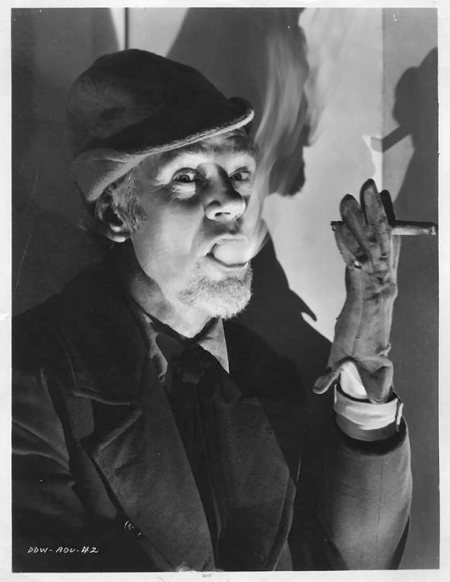
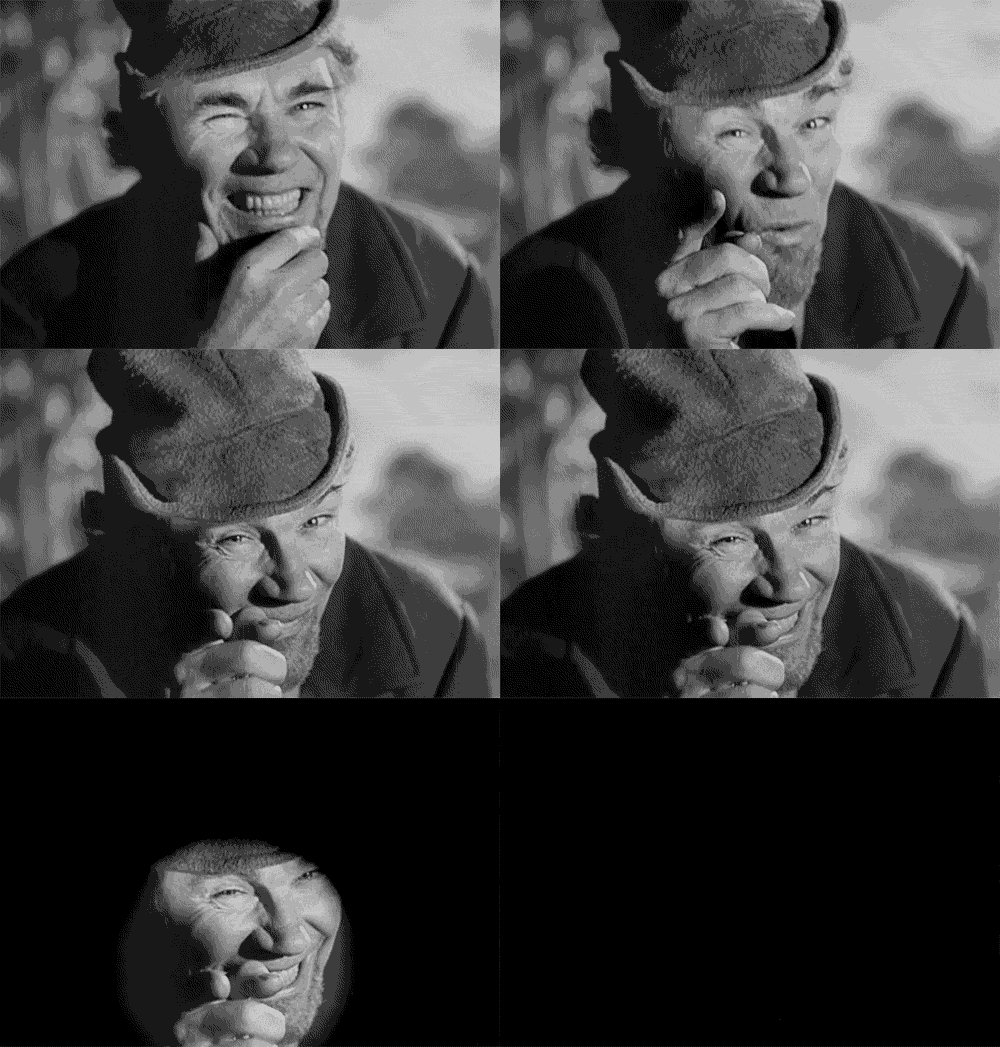
Then on cue, he appears - Walter Huston as the devil, out of a bright, hazy light in the barn. He's amazing in his role. He's a folksy, funny old huckster with some of the best lines. As I said before, you'll actually like the guy! If you're wondering if Walter Huston is any relation to Angelica Huston, yes - he's her grandfather.


The devil introduces himself as Mr. Scratch and hands Jabez his card. Jabez doesn't take it and the card lights into flame and disappears. You will see some pretty impressive special effects for 1941 in this movie. Heck, they're impressive now. In a way, I prefer them to some of the modern, overblown, computerized special effects seen today. Mr. Scratch does a little convincing and it doesn't take much to get Jabez to sign his contract. Mr. Scratch's attitude is pretty much "Soul, Shmoul. You don't need one of those!" After he gets the signature he wants, Mr. Scratch (in another piece of movie magic) writes Jabez's name and the date seven years from then into a tree. Smoke flies from the tree as the devil writes his evil date into it. Jabez has a bit of a wake up call at this point, as he sees that he only has seven years until he has to pay off his bargain.

Jabez and his newfound wealth
During this time we also meet Daniel Webster, a local politician and lawyer who would like to become president. Daniel Webster was an actual man, but it sounds like he was embellished a bit in fiction. In reality he didn't come through for the common people, but he's a very cool character in this movie. The movie version of Daniel Webster would have my vote! He is clearly the smartest one in the story. He's cool, calm headed, able to give a convincing argument or the perfect speech. He cares about the people, he respects those from other political parties for standing up for different views, he loves America and will stand up for his friends. Mr. Scratch would like to have a part in writing Daniel Webster's speeches, but Daniel pretty much tells him to buzz off. At one point he says to Mr. Scratch "I'd rather see you on the side of the opposition." and Mr. Scratch replies quietly "Oh, I'll be there too..."

https://blogger.googleusercontent.com/img/b/R29vZ2xl/AVvXsEj-RRyhzkylbxJ88TNA6q3NpayJt2WY72Hn6-2V5Dw7hDU2XnHHQodratNG0SPvhtLZoVORsWbEYXXd52PX4pC6x2J0p0TtJ4tafCm3knfhqpff2avtIpky7BYjwenKYxhlt5f3YkXmBW3m/s1600/the-devil-and-daniel-webster-6685_1.jpg
Daniel Webster writes a speech while being pestered by the devil.

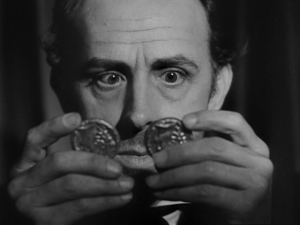
The next seven years go well for Jabez in some ways. He becomes extremely wealthy. He is able to pay off the loan shark and then some! By the way, the actor who played Miser Stevens, the loan shark is one of the best actors in this. I loved watching his smarmy, twitchy, jerky performance. It was so mean and creepy that it was funny. After Miser Stevens is paid off, he notices that Jabez has given him the exact gold coins he already has plenty of. These are unusual coins, and we realize the loan shark is also in league with the devil.
vlcsnap-91244
The creepy Miser Stevens

So Jabez becomes wealthy. He also loses his character as he mistreats his fellow farmers. When the other farmers have a bad growing season, they are forced to take unfair loans from Jabez. He's worse than the loan shark, because he pretends to be their friend and gives them an even worse deal. Then Mr. Scratch creates a massive hail storm, ruining the other farmers' fields. Jabez's wife Mary cries for the other men and their misfortune. Jabez just laughs in their faces and brags about his own "good luck". The other farmers have to suck up their dignity and work for Jabez in hopes of staying afloat.

It's around this time that Jabez and Mary have a son. It looks like Jabez might turn around his evil ways for a brief moment. The devil sees this and decides to up the ante by inviting one of his
"friends" to be a maid for the family. His friend is a female demon named Belle Z. (As in Beelzebub). Belle is played by Simone Simon, who is pretty darn sassy in her role. She was probably walking the line of getting censored for sexiness for a 1941 movie.

Belle and Jabez start their flirty ways
Anyone can guess what happens next. Jabez and Belle have an affair and don't even try to hide it. He and his mistress move into a giant mansion up on a hill, while his wife Mary and his mother live in the old shack below. Jabez and Belle dress in fancy clothes and shove their wealth and relationship in everyone's faces. Jabez is mean to his wife, he's mean to his mother, and he raises his son to be the brat of the century.

Jabez and Mary's son is named Daniel in tribute to Daniel Webster. Mary admires Daniel Webster and asks him to be her son's godfather. You get the feeling that she's known the politician for some time. Mary ends up reaching out to Daniel Webster in an act of desperation. She tells him how her husband has changed and he tells her he will help. As it happens, Jabez has invited Daniel to his house for a party, but I think it was mostly just to make himself look important. Daniel Webster visits Jabez in his grand (almost tacky) mansion and sets him straight. Jabez yells at both Daniel Webster and his wife and continues to make a fool of himself. At that point, Daniel, Mary, and Mary and Jabez's son decide to leave.

Poor Mary, who is completely innocent through this entire movie.
Jabez angrily sits down and of course Belle is there to comfort him. She's just been dancing what could be called a "dance of death" with Miser Stevens, the loan shark. It would seem Miser Stevens' seven years were up. Then the devil appears with a moth that has a tiny little voice that sounds like it belongs to Miser Stevens. Jabez now sees what happens to your soul if you sign it away to the devil. He freaks out and runs to Daniel Webster and Mary. He apologizes and Daniel agrees to help him out. Daniel will act as Jabez's attorney against the devil in a desperate fight for Jabez's soul.

Thus begins a classic scene that was even parodied on The Simpsons! At the end of "The Devil and Homer Simpson" there is a scene with "The Jury of the Damned". There are some pretty funny parts in that clip.


Back to the movie... The devil calls his jury, full of ne'er-do-wells, like Benedict Arnold and a whole pack of pirates. The judge presiding will be Judge Hawthorne of The Salem Witch Trials infamy! The judge doesn't allow much out of Daniel Webster, but in the end Daniel gives an awesome speech. It amounts to this - You were all once Americans, like Jabez. Your freedom was taken from you by the great oppressor - the devil. No one deserves to be oppressed like that. Give this fellow American another chance. It's a really stirring speech, filled with history. Here it is:


Spoiler Alert.... Even these wicked men are impressed by Daniel's speech. Mr. Scratch makes a confused expression that is hilarious. Jabez has his life back. His tacky mansion on the hill burns to the ground. We end with Daniel Webster sitting down with Jabez and his family for dinner, along with all the other farmers. Jabez's mom comes out with a peach pie made especially for Daniel Webster. Ah, but when she lifts the pie lid, it's gone! It appears the devil has been at work again.


The Devil and Daniel Webster is the best movie I've seen in a while! See if you can find it. I had some luck finding it at a local library. It will make you think, it will make you mad, and it will make you laugh. I just know you'll appreciate the Hitchcockian style shadows and excellent music too!

Speaking of the music, I'll end with one of the songs from the movie. This song, "Sleigh Ride" is what got the initial conversation going about The Devil and Daniel Webster. Never mind the sweet Christmas images in this video. The song is actually kind of frenetic and unnerving!

Witchy Women

| | 0 comments
Circa 1940